3D Snowflake Christmas Spinner
The holiday season often feels like a race against time, where the pressure to create something special collides with limited hours in the day. For makers, designers, and hobbyists who spend their days crafting digital assets or physical products, finding a project that balances technical precision with festive joy can be a refreshing change of pace. Enter the 3D Snowflake Christmas Spinner, a design that transforms standard 3D printing capabilities into a kinetic piece of decor. It is not just another static ornament; it is an interactive experience that invites users to engage with geometry, motion, and light.
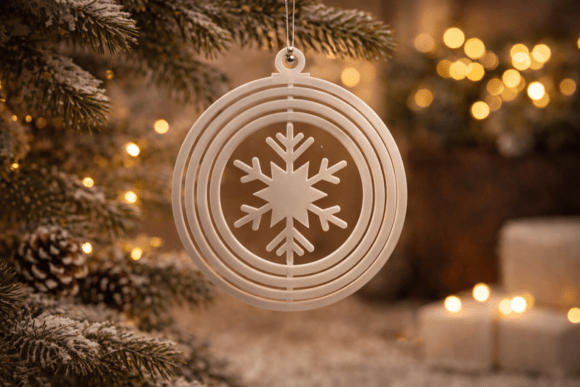
This model stands out because it merges the intricate beauty of fractal geometry with the mechanical satisfaction of assembly. Unlike traditional ornaments that are printed as single solid objects, this spinner relies on a clever multi-part architecture. The design features a detailed snowflake at its core, surrounded by three concentric rings. Each component is distinct, allowing for bold graphic contrasts through multi-color printing. When assembled, these pieces slot together to create a characteristic spinning effect, turning a simple window display or tree decoration into a mesmerizing dance of movement.
The Architecture of Motion
What makes this particular design so compelling for creators is its engineering simplicity. The top and bottom caps are designed to be removable, which eliminates the need for complex internal supports or glue. You insert the rods and rings directly, relying on precise tolerances rather than adhesives. This modular approach is a lesson in good design: it prioritizes ease of assembly and repairability. If one ring wears down or you want to swap out a color scheme, you can do so without destroying the entire piece.
The "swindle" spinning effect mentioned in the design notes refers to the smooth, friction-based rotation enabled by the fit between the rings and the central axis. To achieve this, your slicer settings must be respected. The model allows for free resizing within your slicing software, offering flexibility for different tree sizes or display contexts. However, scaling requires attention to detail. As you increase or decrease the size, you must adjust clearances and tolerances manually. A slight mismatch in scale can result in a jammed mechanism, while too much looseness removes the satisfying tactile feedback of the spin. This process encourages a deeper understanding of how digital models translate into physical reality.
Creative Applications and Multi-Color Potential
One of the most exciting aspects of this ornament is its potential for visual storytelling through material choice. The design explicitly encourages each ring and the central snowflake to be printed in a different filament. This opens up a world of creative possibilities beyond the traditional red-and-green palette.
- Gradient Effects: Use translucent filaments in varying shades of blue or purple to create a frosted glass look when the spinner rotates.
- High Contrast Graphics: Print the outer rings in a matte black and the inner snowflake in bright white or neon yellow for a bold, modern aesthetic that pops against dark tree branches.
- Thematic Cohesion: Match the filament colors to your home’s interior design theme. Gold and cream for a classic luxury feel, or silver and gray for a minimalist winter wonderland.
For marketers and small business owners, this versatility offers a unique branding opportunity. Imagine creating custom spinners for client gifts, using your company’s brand colors for each layer. The spinning motion draws the eye, making these items memorable conversation starters. Educators can use this project to teach principles of physics, such as angular momentum and friction, while students assemble their own kinetic art.
Technical Execution for Best Results
To ensure your 3D Snowflake Christmas Spinner functions smoothly, adhering to specific printing parameters is crucial. The design is optimized for materials like PLA or PETG, both of which offer the necessary rigidity and slight flexibility required for the snapping fit of the components.
- Nozzle Selection: A 0.4 mm nozzle is ideal for capturing the fine details of the snowflake center. If you have a larger nozzle, you may need to adjust the model resolution, but the standard setting works best for clarity.
- Layer Height: Setting your layer height between 0.16 mm and 0.2 mm provides a good balance between surface finish and print speed. Thinner layers might improve the smoothness of the rotating rings but will significantly increase print time.
- Wall Perimeters: Aim for 2–3 perimeters. This ensures the structural integrity of the thin rings without adding unnecessary weight that could hinder the spinning motion.
- Infill Density: An infill of 10–20% is sufficient. Since the strength comes from the wall thickness and the interlocking design, high infill is redundant and wastes material.
- Supports: If you orient the model flat on the bed, supports are generally not needed. This simplifies post-processing, allowing you to focus on assembly rather than removing support structures.
When scaling the model, remember that thermal expansion and extrusion variances can affect fit. It is wise to print a test version first if you plan to scale by more than 10–15%. Adjust the X/Y dimensions in your slicer slightly (e.g., +0.2 mm) to compensate for any tightness, ensuring the rings rotate freely once assembled.
Display and Engagement
The functionality of the spinner extends beyond the printer bed. The small loop at the top is strategically placed to allow easy hanging. While traditionally used on a Christmas tree, this design shines in other environments. Hanging it in front of a window allows natural light to pass through the open spaces of the snowflake and rings, casting dynamic shadows that move with the breeze. This adds a layer of ambient animation to your workspace or living area.
For content creators and bloggers, this object serves as excellent visual content. The act of assembling the spinner—watching the rings click into place and then observing them spin—creates engaging video material. It demonstrates the intersection of design, technology, and tradition. By sharing the process, you provide value to your audience that goes beyond a simple product showcase; you offer inspiration and practical knowledge.
Conclusion
The 3D Snowflake Christmas Spinner is more than a seasonal decoration; it is a testament to the power of thoughtful 3D design. It challenges the maker to think about tolerances, materials, and aesthetics simultaneously. Whether you are looking to add a touch of kinetic elegance to your holiday decor, create unique gifts for clients, or simply enjoy the meditative process of assembly, this model delivers. By embracing its modular nature and experimenting with color combinations, you transform a digital file into a tangible expression of creativity. In a world of mass-produced goods, the hand-assembled, multi-colored spinner stands out as a personal, functional work of art.